
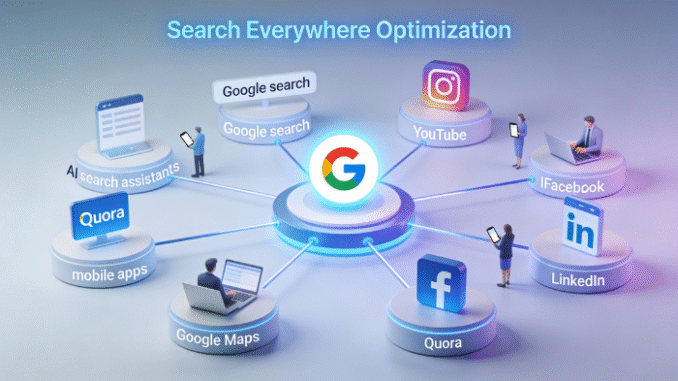
In today’s digital world, simply ranking on a search engine is no longer enough; your brand must show up wherever your audience spends time online, and this holistic approach is known as Search Everywhere Optimization. When you move beyond Google and intentionally optimize your presence across social media, YouTube, Quora, app stores, maps, and modern answer platforms, your overall Marketing Fundamentals Explained in action become far more powerful. This kind of strategy not only drives traffic but also strengthens trust, boosts visibility, and builds long-term brand recall for your business.
What Is Search Everywhere Optimization?
Search Everywhere Optimization simply means: wherever your audience can search, you should be visible. It is not only about “search engine optimization”, but also about “platform-wise optimization”.
Its focus includes:
- Search engines like Google and Bing
- YouTube and short video platforms
- Social media search (Instagram, Facebook, LinkedIn)
- Local search (Google Maps, local listings)
- Answer platforms and forums
When a brand is optimized on every touchpoint, users see the same name again and again, which builds authority and familiarity. That is why Search Everywhere Optimization has become a practical and powerful approach in the modern digital era.
Why Is Search Everywhere Optimization Important?
Earlier, people mainly searched on Google, but now the audience is scattered across many platforms. Some search for products on YouTube, others through Instagram hashtags, and some directly on Amazon or Flipkart.
That means:
- Depending on only one channel is risky.
- Multi-platform presence improves brand recall.
- The chances of organic discovery increase many times.
When you follow Search Everywhere Optimization, your content appears in front of the user everywhere – whether they are watching a video, scrolling reels, or looking for an answer to a question.
Core Principles Of Search Everywhere Optimization
This concept is not about posting randomly everywhere; it is a planned strategy. Some basic principles are:
- Consistency in Branding
Use the same brand name, logo style, and tone on every platform so that users can recognize you instantly. - Platform-Specific Optimization
Every platform has a different algorithm. On YouTube, thumbnails and watch time matter; on Instagram, hooks and engagement are important; on Google, keywords and on-page structure are key. - Understanding User Intent
Users search in different ways: on Google they type questions, on YouTube they look for explanations, and on Instagram they seek inspiration. The main rule of Search Everywhere Optimization is to create content according to each intent. - Content Repurposing
Convert one idea into multiple formats – blog post, short video, carousel, reel, thread, and answer post.
These elements together make the Search Everywhere strategy scalable and effective.
Connection With Marketing Fundamentals
If you look closely, Search Everywhere Optimization is completely based on the basic principles of marketing. When you plan your target audience, positioning, messaging, and channels in a systematic way, this becomes not just a digital trick but a long-term marketing strategy.
- Audience Understanding: You must know where your customers spend their time online.
- Value Proposition: Your message should be clear and consistent on every platform.
- Branding: The more consistent your visuals and tone are, the more memorable your brand becomes.
So, people who understand the base of marketing will see Search Everywhere Optimization as a practical extension of those fundamentals.
How To Start: A Simple Step-by-Step Approach
You can implement this concept easily with a step-by-step approach:
- First, clarify your main topic or niche.
- Choose one primary content source such as a blog or YouTube channel.
- Break that content into smaller pieces and turn it into reels, shorts, carousels, and snippets.
- Optimize titles, descriptions, hashtags, keywords, and visuals separately for each platform.
- Use links smartly on every platform to drive users to your website, landing page, or lead magnet.
The more naturally and frequently your name appears across platforms, the more effective your Search Everywhere Optimization will become.
Common Mistakes In Search Everywhere Optimization
Many people think this concept only means posting everywhere, but that mistake makes the strategy weak.
Some common mistakes are:
- Copy-pasting the same caption on every platform.
- Ignoring the audience and chasing only the algorithm.
- Inconsistent visual quality and branding.
- Focusing only on vanity metrics (likes, views) and ignoring conversions and brand impact.
Search Everywhere Optimization becomes powerful when you focus on long-term presence, positioning, and trust building – not just on getting one viral moment.
The Future Of Search Everywhere Optimization
In the future, AI search, voice assistants, and answer-based platforms will continue to grow. People will move more toward direct answers, summarized information, and conversational results. In such an environment, the brands that are contextually relevant everywhere will be the ones that win in the long run.
That is why it is important to start focusing on multi-platform visibility, structured content, and smart linking from today. Search Everywhere Optimization is not a one-time campaign, but a continuous process that makes your brand a little stronger every year.
Conclusion
If you want your brand not just to rank, but to stay in people’s minds, Search Everywhere Optimization must become a core part of your digital plan. When you create a consistent brand experience across multiple platforms based on user intent, you do not just gain traffic – you also earn authority and trust.
This smart approach is a real competitive advantage in today’s market. If you are serious about long-term growth, visibility, and brand power, start adopting the Search Everywhere mindset today, begin experimenting, and take your presence to the next level. To understand and apply this journey in a more systematic way, make sure you include a perspective like SEOshastra in your overall strategy.
Leave a Reply